
- Fewer arguments. Every call has its evidence.
- The same judging. Every run, every round, all season.
- Your rules. Your points, your briefing, your last word.
The presentation
 Download the brochurePDF · 16 pages
The whole system, in one film.
From the box on the car to the score on the screen: how DRIFT/RS AI Judging measures every run to the centimetre, scores Line, Angle and Impact, catches what a judge can miss, and plays it all back in 3D. Set up and validated at the Drift Kings 2026 Final.
Download the brochurePDF · 16 pages
 3D demo lap · online nowReplay a real lap in 3DDriven at Serres. Speed, angle and throttle as the system measured them, right in your browser.
Self-learning AI judging · live results & 3D replays at every event
Learning From Every Run. Judging Every Run Better.
DRIFT/RS AI Judging reads every car twenty times a second, to the centimetre, and turns it into Line, Angle and Impact scores that get sharper with every lap it sees. It learns each course by itself, catches the mistakes a judge looks for, and shows exactly where every point came from.

—laps analysed
—course layouts learned
—clean laps in its ideal line
Counted live from the judging system's own memory, test sessions included.
Who it is for
Better for the organizer. Fairer for the driver. Clearer for the fans.
- Judged on what you did. Measured to the centimetre.
- No mystery. A report shows where every point went.
- Practice that teaches. Every lap recorded and scored.
- Understand the score. Every score is explained.
- See what the judges see. 3D replays on your phone.
- Miss nothing. Mistakes are flagged live on screen.
Feature 01 · Self-learning AI Judging
Rules give it the framework. Every lap makes it sharper.
DRIFT/RS AI Judging doesn't wait to be taught. Every run it measures becomes experience: it learns what a good angle, a fast initiation and a close chase look like on each course, draws its own ideal line from the cleanest runs, and remembers where the field brakes. The more it sees, the better it judges, all by itself.

Rule intelligence
Built on how drifting is actually judged: the Drift Kings 2026 rules and drivers' briefing, the Formula Drift 2026 judging regulations, the Drift Masters guidelines and FIA reference material. Zones, clipping points, angle, fluidity, commitment and every major mistake.
Learns every layout
Each course teaches it its own targets: the peak and average angle that count as strong, how quickly a good rotation reaches its angle, the entry speed and pace of a fast lap, and how close a real chase runs.
Draws its own ideal line
From the cleanest runs on that exact course, refined with every new one, so the line is measured against what the track really rewards.
Remembers the pace
It learns where the field brakes on each layout, so a lead that checks up somewhere unusual stands out immediately.
Never starts from zero
Every layout keeps its own memory. Bring a venue back and its targets, ideal line and pace history return with it, and one venue never colours how another is judged.
01 / MEASURE
Centimetre-accurate, twenty times a second.
Two antennas and an RTK receiver on every car give position and heading. From that it derives speed, the true drift angle, the throttle, and all four tyres against the mapped track limit.
02 / LEARN
Teaches itself every course.
Targets, ideal line and braking map are learned automatically from the laps it has analysed, practice laps included, with nobody at the console. No hand-tuning between events.
03 / ANALYSE
Any case, at any moment.
Understeer, wheels off, a spin, a late initiation, contact and who caused it, a lead breaking pace, a pass. Every case is detected automatically, flagged live on screen and scored the same way every time.
04 / EXPLAIN
A judge that shows its work.
No guessing. Every point traces back to a measurement, and every lap comes with its own report: each zone's depth and coverage, angle held, corrections, rotation speed, entry speed, and the reason behind every point.
Developed during training sessions and validated on track at the Drift Kings 2026.
Set up and run at Serres Racing Circuit during the final round. Every session adds laps to its memory and sharpens its judgement. The goal: introduce DRIFT/RS AI Judging as a highly trained, perfectly consistent judging tool and the only judge at the track that remembers every lap and every battle it has ever evaluated.
● SELF-LEARNING AI
Feature 02 · The score
All 100 points. Every one of them measured.
Line, Angle and Impact, split the way the Drift Kings rules and drivers' briefing split them. Impact is not a feeling here: it is rotation speed, entry speed, throttle and momentum, read from the same centimetre positions as everything else. It can score the whole run, or sit beside your judges as an advisor while the final call stays theirs. Either way, every lap comes with its report: every point, and the reason behind it.
LINE40
- Zones and clipping points30Shared equally between them. Outer zone: how deep the rear bumper goes, and for how much of the zone. Inner zone: the same with the front. Clipping point: the bumper it asks for, nose or tail, within half a metre.
- Connection10How closely the car follows the ideal line this layout has learnt, and every correction of the line on the way.
ANGLE30
- Average angle12The angle held from the attack line to the finish, against the target this layout has learnt.
- Peak angle8The most angle reached in the run.
- Corrections10Each time the angle dips more than 5° and comes back, 2 points go. A dip deeper than 10° costs 3.5.
IMPACT30
- Fluidity15Rotation speed, 8: how quickly the car swings to its angle, the initiation counting double. Smooth rotations, 7: each one in a single move.
- Commitment15Entry speed at the attack line, 4. On the throttle into the initiation, 3. Momentum, 4: no slowing where the layout doesn't ask for it. Speed through the run, 4.
- Early initiation+3A bonus for initiating well before the attack line, up to 40 m.
The event's own points
Line out of 40, 50 or 60. Angle out of 30 or 20. Impact takes the rest of 100. The judges choose the weighting for the event, and every part keeps its share of it.
Tandem battles
Each lead and each chase gets a quality from −5 to +5. The chase is judged on closeness, consistency and how well it mimics the lead's line, angle and transitions. The two sides add up to a suggested winner, or One More Time.
WHY THESE POINTS
“Why did I get 77?” Here is the answer.
Every driver asks. Now every lap comes with its own report, and every point in it traces back to a measurement.
One button next to every replay. Everything that was measured and decided for that run, on one page: the verdict, each zone, the angle against the layout's targets, every part of Impact, the briefing rules in force, and what happened when, timed from the start line. For a battle, the gap, the mimic and the comparison too.
77.0points of 100 for this lap, every one of them explained
124km/h at the attack line
100km/h on average through the run
5/6zones and clipping points reached
“Why these points”: the report of a real lap. Serres Racing Circuit, 3 October 2026, 13:45.
Feature 03 · What it detects
It sees what a judge sometimes doesn't see. And flags it live.
Every case below is detected automatically from the telemetry, shown on the broadcast the moment it happens and folded into the score. Each one is shown twice: close up on the track, and, small in the corner, in the live view with its data. Tap either picture to see it full size.
UNDERSTEER
Understeer detection
Straight for longer than the course's own learned transition time: flagged live and deducted. A full second loses the run, decel zones included: they let a car lose speed, never its angle.
CONTACT
Contact, and who caused it
The body-to-body gap closes to nothing with a sudden drop in speed. It even tells which car caused it: here the chase closed in too fast. When the lead brakes hard instead, it says so.
1 WHEEL OFF
One wheel off
All four tyres are checked against the mapped track limit twenty times a second. A tyre is off only when the whole of it is past the limit. It knows exactly which one went off, marks it on screen, and takes 2 Line points.
2 WHEELS OFF
Two wheels off
Two or more wheels off the track at once is a major mistake: the run scores zero, exactly as the Drift Kings rulebook lists it.
LEAD BROKE PACE
Deceleration of the leader
The lead brakes hard mid-drift and the chase has to straighten to avoid it. The lead's braking is flagged when it happens outside a decel zone and is more than the bend ahead needs, or where this layout's field never brakes. The gap that opens there is not held against the chase, and a lead whose braking upsets the chase loses its run.
POSSIBLE PASS
Overtake detection
Side by side, both drifting, and the chase's nose gets ahead. That's measured along the racing line, not in a straight line, so simply running alongside on the inside of a bend isn't mistaken for a pass.
INCOMPLETE
Incomplete runs, called on the spot
The attack line is the last place to initiate: a car that isn't drifting there scores zero. So does a spin, or a car that stops. Each one is named on screen the moment it happens, and the judges can still count the run.
EARLY THROTTLE
The chase that gets back on it first
After a transition or a decel zone, the chase is back on the throttle while the lead is still off it. EARLY THROTTLE flashes over its tag: the mark of an aggressive chase, found from both cars' speed twenty times a second.
Feature 04 · The 3D replay
Every run again in 3D. With what no camera shows.
Seconds after a run it plays back in 3D on the broadcast, on Race control and on any phone: both cars, with their speed and angle floating above them. Three more things are drawn straight from the data.
TYRE MARKS
The line, drawn on the track
Both rear tyres leave a mark wherever the car is sliding, in its role's colour: cyan for the lead or a qualifying car, magenta for the chase. In qualifying you read the line that was driven. In a battle you see where the chase followed the lead's line, and where it left it.
PROXIMITY HALO
A halo under the chase
From the attack line to the finish, a light on the road under the chase car shows how close it is to the lead, body to body: green under 1 m, orange under 3 m, red beyond. Its tag says the same: proximity perfect, average or bad. The two distances are set for each event.
THROTTLE
On, holding or off the throttle
No sensor on the pedal. It is read from the car's own speed over the 0.8 seconds round each moment: gaining 0.5 m/s² or more is on throttle, green. Losing 1.8 m/s² or more, about 0.18 g, is off throttle, red. Anything between is holding, orange, because a drift scrubs a little speed with the throttle still in.
CAMERAS
Every angle
Broadcast, 3/4 rear, 3/4 front, TV and high views, or a free camera you can pinch out to the whole layout. Each replay opens with a slow turn round the cars.
BANKING
Banked corners
The road's height is measured from the laps themselves, so a banked corner tilts in the replay the way it does on the track.
VIDEO
Any replay as a video
One button on Race control saves a replay as a 1080p MP4 with the logo in the corner, ready to post.
Feature 05 · At the event
Set it up for the day. Then it runs itself.
Map the layout, give it the judges' briefing, put a box in each car. From then on laps are found, scored and published without anyone at the console.
MAPPED IN MINUTES
Any layout, walked once
Walk the course with one of the boxes and a phone, or start from a known circuit like Serres and set the lines, zones and clipping points on its real map. Save it as a layout, and it comes back with everything it has learnt about it.
RACE BRIEFING
The judges' briefing, applied
Every event has its own amendments: transition before the decel zone, attack on the left side. Each becomes a rule the scoring measures, with where, what and the penalty, in the judges' own words. The rules belong to that event only, and show in every result they touch.
RACE LEARNING
Learns while nobody watches
Switch it on before practice: every lap is detected, scored and remembered. By qualifying, the layout already has its targets and its ideal line.
JUDGES
The judges keep the last word
Count this run, or zero it: one press overrides any automatic call. OK, lower or higher on any score, with the reason, tunes what the layout expects from the next lap.
NO ARMING
Laps that find themselves
Each box remembers its last five minutes and sends again whatever the laptop missed. A lap is recognised from the start line to the finish with nobody arming it, a battle from two cars starting together, even where the start line is out of Wi-Fi range. Afterwards it only asks who it was.
In the picture: the flat square on the lid is the box's GNSS antenna, the stick is its Wi-Fi antenna.THE BOX
Two antennas, one box
One antenna on the box, which rides on the boot, one on the roof. Position from the first, heading from the pair, and the distance between them shown to the millimetre.
SATELLITES
The sky, live
A 3D globe shows every satellite the base station is using, from GPS, GLONASS, Galileo and BeiDou: more than thirty at a time.
ANYWHERE
Batteries and Wi-Fi
Base station, access points, boxes and laptop all run on batteries. The corrections reach the cars over the same Wi-Fi as their data, and the internet is only needed to publish the results.
Feature 06 · What I've learnt
An AI that tells you what it knows.
The judging system keeps its own page, written in its own words, with live counts straight from its memory and every formula it uses. Here is the short version.
“I'm the part of DRIFT/RS AI Judging that turns telemetry into a Line, Angle and Impact score. I've read the rulebooks of the series that matter, I learn every layout from the laps driven on it, I draw my own ideal line from the cleanest runs, and I show my work — every point traces to a measurement. And I keep scanning the internet for reliable, valuable input on drift judging.”
— DRIFT/RS AI JUDGING, IN ITS OWN WORDS
—laps processed in total
—course layouts learned
—lead & qualifying laps studied
—chase laps studied
What it has studied
Drift Kings 2026 rulesDrift Kings drivers' briefingFormula Drift 2026 judging regulationsFIA drifting guidelinesDrift Masters briefings & knowledge centreFormula Drift judging breakdown video
- Learns on its own. Every completed lap, practice included, updates that course's targets, ideal line and braking map.
- Remembers every layout. Load a saved venue and all of its learning comes back with it.
- Nothing is a guess. Every point traces back to a measurement and a learned target.
Feature 07 · AI live
Every run, judged and online in seconds.
During an event the scores, the battle results and a 3D replay of every run go online as each run finishes, on any phone. Each event day stays up until midnight, then the page is cleared for the next round.
Checking the track…- 3D replay of every run. Broadcast camera, both cars, live angle, speed, throttle and gap, and each car's tyre marks in its role's colour.
- Qualifying and battles, as they happen. Standings update seconds after each run.
- Every score explained. Open any run to see where its Line, Angle and Impact points came from.

Complete race management
One platform. From judging to the final broadcast.
Drift.RS connects the core operations of a drift event so judges, race control, drivers, spectators and the livestream work from the same race data.
AI Judging
Self-learning Line, Angle and Impact judging from centimetre-accurate RTK telemetry, twenty times a second. It learns every course by itself, follows each event's briefing, detects understeer, wheels off, spins, contact and pace breaks live, and explains every point. Developed during training sessions and validated on track at the Drift Kings 2026.
Live qualification
Every judged lap in every class, published as it is scored. Rankings move in front of the audience, and anyone can open a driver to see both laps and the judge breakdown behind the number.
TOP32 racing
The full ladder from TOP32 to the final, the battle on track now, and the battle on deck next. Winners advance on screen the moment the call is made.
Broadcast layer
A transparent browser source you drop into OBS. Battle names, entry numbers, bracket position and race status go on screen without anyone touching the scene during the show.
Admin tools
Export raw results to XLS, print A4 result sheets for the paddock, and generate result graphics sized for social posts, all from the same data.
Hosting and support
Fully web based and hosted on our servers. No installs on your machines, no local network to babysit, and updates arrive without a migration.
Qualification
The crowd stops asking who is leading.
Scores appear as the judges submit them, so the standings on the fence match the standings in the tower. No printed sheet taped to a trailer, no waiting for the PA.
- Both laps, always visible. L1 and L2 with the judge split behind each one.
- Every class, one link. PRO, PRO2 and Queen run side by side all weekend.
- Built for phones. Big numbers, readable in daylight, on track Wi-Fi or mobile data.
- Entry numbers and flags. Spectators match the car on track to the name on screen.

Live qualification standings, Drift Kings 2026 Final, Greece.
Live racing
The TOP32 ladder fills in while the tandems are still running.
Once qualifying closes, the bracket takes over. Every result moves a driver forward on screen, so teams, commentators and the crowd always know what just happened and what is next.
- TOP32 to the final. Both sides of the ladder, plus the third place battle.
- Colour coded states. On track, lead, winner, judging, incident, bye run and OMT.
- Seeding stays visible. Qualifying position sits next to every driver through the ladder.
- Your partners on the board. Series and sponsor logos sit in the same layout.

PRO Series TOP32 ladder, ready for the first battle.
OBS overlay
Your stream calls the race for you.
Add one transparent browser source to your scene. The tower sets the race state and the overlay follows on its own: on track, judges deliberating, one more time, track incident, bye run and the winner, with the next opponent, the road to the final and the podium. Nobody switches graphics mid battle.
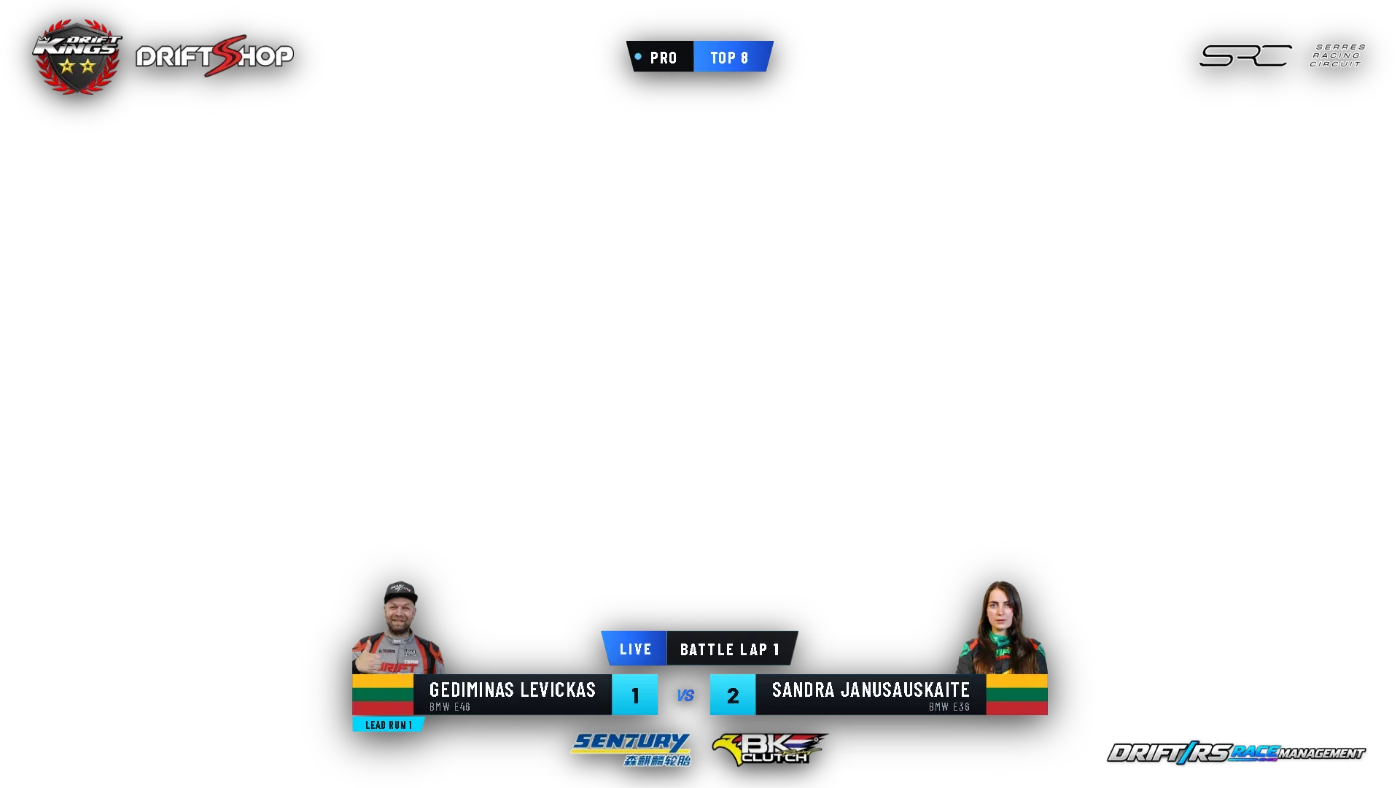
A layer, not a picture.
Everything outside the graphics is transparent, so your camera feed shows through untouched. Series logos, circuit branding, sponsor marks and the Drift.RS badge are placed once and stay put for the whole broadcast.
Setup
One race database. Every output stays connected.
01 · EVENT DATA
Load the entry list
Drivers, entry numbers, cars, flags and classes go in the same way you would fill a spreadsheet. Import what you already have from registration.
02 · JUDGING
Score and publish
Scores go in from the tower and publish immediately. Rankings, tie breaks and the qualifying order are handled for you.
03 · RACE + BROADCAST
Run the bracket and stream
Post one link for the crowd and drop the browser source into OBS. That is the whole setup, on any event, anywhere.
Bring it to your next round.
Tell us the series, the classes and the dates, and we will set the event up with you. Drift.RS runs every Drift Kings International Series round, and the pages below are the live ones drivers and fans use trackside.